A provocation worth taking seriously
Social media has just resurfaced a clip from a talk Yuval Noah Harari gave about a year ago, in conversation with Luciano Huck at Fronteiras do Pensamento in Rio de Janeiro. It should make anyone in STEM education sit a little less comfortably. He argues that many of the things we (used to) value most in education, and he names maths and engineering as examples, are the things AI will take over most easily.
If you haven’t come across him, Harari is an Israeli historian at the Hebrew University of Jerusalem and the author of Sapiens, which has sold tens of millions of copies worldwide. He’s best known for telling the whole sweep of human history, and lately he’s turned that lens on AI, most recently in his book Nexus, which is pretty much essential reading.
His reasoning is simple. If a skill is narrow and mostly cognitive, if it’s mostly about “numbers or words or drawings on charts”, it’s exactly what machines are getting good at. What’s more uniquely human, he says, are disciplines that combine the mind with the body and with other people. His example is martial arts: you train your mind, you train your body, and there’s always another human being in front of you.
It’s a good provocation. But I think he’s put engineering in the wrong pile.
Where he’s right
To be fair to Harari, he’s describing something real. If engineering means working through a set of calculations on a worksheet, or labelling a diagram for an exam, then AI will have that covered. Quite a lot of it already does.
The same goes for a certain idea of critical thinking: weighing evidence, spotting the flaw in an argument, picking the best option from a list. These are valuable skills, and we should keep teaching them. But on their own they’re precisely the abstract, symbolic kind of thinking machines handle well.
The trouble is that we’ve often taught STEM as if that’s all there is. Engineering gets reduced to the bit that fits on paper, and then we’re surprised when someone says a computer can do it.
Thinking doesn’t stop at the neck
There’s a whole field of research that explains why. It’s called embodied cognition, and the core idea is that we don’t think with our brains alone. We think with our bodies, our senses, our movement and the things we handle.
The old picture treated the brain as a computer. Information comes in, gets processed somewhere behind the eyes, and instructions go out to the body. Embodied cognition says that’s backwards. A lot of our understanding is built through doing. Your hands, eyes and sense of balance aren’t just carrying out orders. They’re part of how you work things out in the first place.
A few ideas sit underneath this:
- Tacit knowledge. The philosopher Michael Polanyi put it neatly: “we can know more than we can tell”. An experienced mechanic hears that an engine is wrong long before they can explain why. That knowledge is real, but it lives in the body, not in a sentence.
- Learning through action. Much of what we understand comes from a loop of doing, feeling the result and adjusting. Take the doing away and the understanding is thinner.
- Moravec’s paradox. AI researchers noticed decades ago that the things we find hard, like chess or advanced maths, are relatively easy for computers. The things a toddler does without thinking, like picking up an odd-shaped object or keeping balance, are fiendishly hard. Robotics is closing that gap, but slowly, and the gap is the point: physical, sensory judgement is the harder problem.
Put that together and Harari’s argument starts to look like a case for engineering, as long as it’s the real thing.
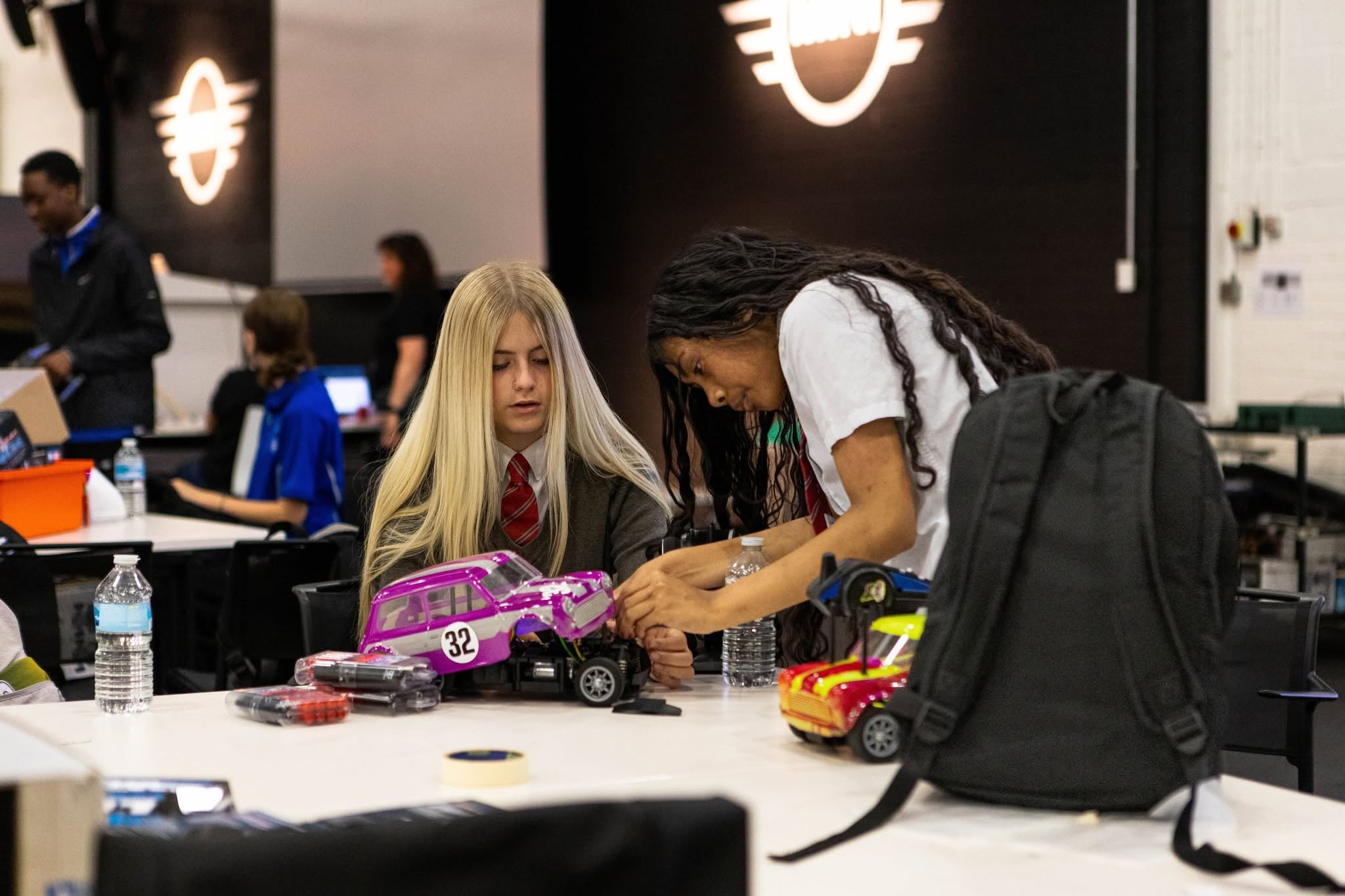
Feel: what it looks like at the track
Spend an afternoon at an RC race meeting and you’ll see embodied cognition everywhere.
A young driver comes off the rostrum after a heat and says the car “feels too safe, too easy to drive”. That’s not a measurement. No sensor told them that. It’s a judgement built from thumbs on the transmitter, eyes tracking the car into the corner, and hours of laps that have tuned their sense of what “right” feels like.
Then the engineering starts. A car that feels too safe is forgiving but dull, so is the chassis flexing too much and soaking up the response? Too much toe or not enough droop? They try a change, go back out and feel the difference, or don’t. Every run is an experiment, and the most important instrument in it is the driver.
As a former motorcycle racer and race engineer, I can tell you this is exactly how it works at full scale. Data loggers are brilliant, but the best sensor was the rider.
Intuition isn’t the opposite of engineering. It’s what engineering experience turns into, and racing is especially good at nurturing it.
Critical thinking is only part of the picture
We talk a lot about critical thinking in our work, and rightly so. It’s essential. But in that pit-lane moment, critical thinking is only one of several things happening at once:
- Sensing. Noticing what the car is doing through hands, eyes and timing.
- Intuition. A hunch about the cause, built from experience long before it can be put into words.
- Reasoning. Testing that hunch against what you know about set-up and physics. This is where critical thinking comes in.
- Making. Physically changing the car, with fine motor skill, under time pressure, with precision and accuracy.
- Talking it through. Explaining a feeling to a team-mate or pit buddy who wasn’t holding the transmitter, and listening to their view.
- Handling the result. Living with a bad call in front of other people, staying calm and going again.
Take critical thinking out and the loop breaks. But take any of the others out and it breaks just as badly. It’s that combination of mind, body and other people that Harari says AI can’t replicate, and it’s sitting right there in engineering, as long as we let young people do it rather than just read about it.
A year on: what’s changed?
Harari spoke in November 2025. So it’s fair to ask how much has moved since.
On the AI side, quite a lot. Stanford’s 2026 AI Index reports that an AI system reached gold-medal standard at the 2025 International Mathematical Olympiad. AI agents went from completing around 12% of real computer tasks to around 66% in a year, close to the human baseline. On the narrow, cognitive stuff, Harari’s prediction is arriving early.
But the same report has a telling number: robots succeed at only about 12% of real household tasks. Moravec’s paradox is alive and well. The physical, messy, hands-on world is still where machines struggle most.
And our education system? The Curriculum and Assessment Review published its final report on 5 November 2025, the same month as the talk. The government’s response promises a new national curriculum from September 2028, with an oracy framework and enrichment benchmarks, which are genuinely whole-person steps. Then in January 2026 the DfE announced AI tutoring tools for up to 450,000 disadvantaged pupils, due by the end of 2027. Even the Education Endowment Foundation warned that the evidence on AI tutoring is still in its infancy.
So here’s the thought I keep coming back to: In twelve months, AI has raced ahead on exactly the skills Harari said it would. In the same twelve months, our biggest moves have been a curriculum that won’t land until 2028 and more learning through a screen. That feels like we are still doubling down on the skills machines are taking over, while the hands-on, embodied learning they still can’t touch stays at the margins.
So what should we teach?
If Harari is even half right, the answer isn’t less engineering. It’s more of the hands-on, embodied, social kind, and less of the version that only lives on paper.
For schools and youth programmes, that means:
- Let young people build, break and fix real things, not just simulate them.
- Value feel and intuition as part of engineering, not as guesswork to be trained out.
- Make it social. Teams, competition and explaining your thinking to someone else are part of the learning, not a distraction from it.
- Treat setbacks as data. A bad run that you learn from is worth more than a perfect worksheet.
- Make it ongoing. Persistence and resilience are built over months, not in an afternoon. Keeping it real means coming back week after week, so one-off, set-piece activities don’t cut it.
That’s why we use RC racing at RC Vision. It isn’t because we want every young person to become a racer. It’s because a car, a track and a group of people turn engineering back into what it really is: a whole-person skill.
So maybe the question isn’t whether we should still teach engineering at school in an age of AI. Maybe it’s whether we’re teaching the version a machine can’t do.
Leave a Reply